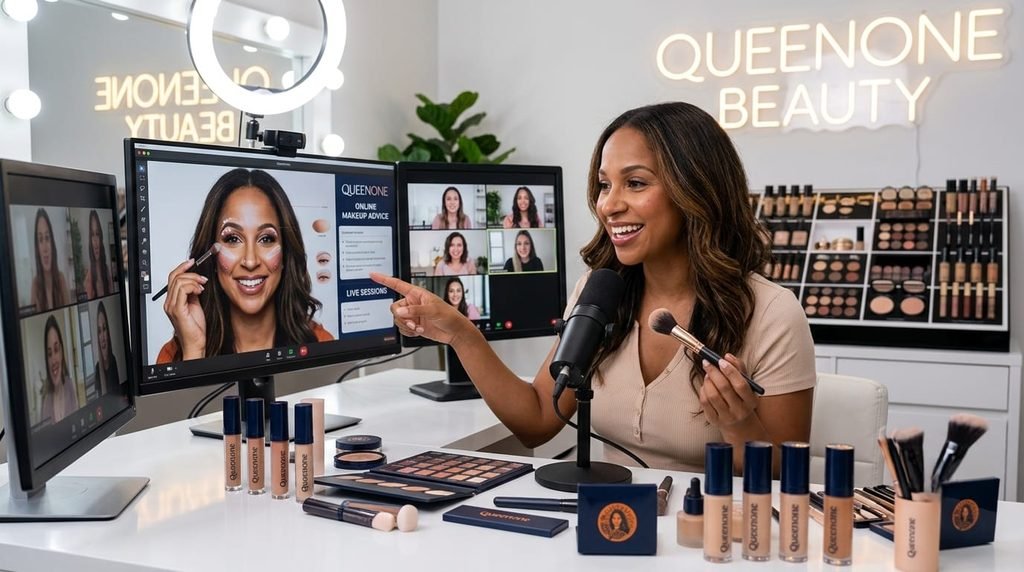
Queenone is positioned around a simple but powerful idea: beauty recommendations should feel personal. Instead of forcing people to scroll through endless makeup tutorials, product pages, trend reports, and contradictory social media advice, an AI-powered beauty recommendation experience can help narrow the journey toward suggestions that are more relevant to the individual. That matters because makeup is rarely a one-size-fits-all decision. A lipstick that looks incredible on one person may not create the same effect on another, and a full-glam routine that works for a creator on social media may be completely impractical for someone getting ready for work in five minutes.
For people in the United States, the beauty market offers an extraordinary amount of choice, but choice can quickly become confusion. Consumers can compare prestige brands, drugstore products, direct-to-consumer launches, viral trends, professional tutorials, and thousands of shades and formulations. Queenone aims to bring AI makeup suggestions and personal beauty recommendations into that crowded environment, creating a more guided discovery experience. The goal is not simply to tell everyone what is popular. The more useful question is, what may be relevant to you?
That direction closely reflects where the beauty industry is heading. McKinsey’s 2026 beauty research found that consumers increasingly connect beauty with feeling confident and taking care of themselves, while the industry continues to adapt to more individualized expectations. For a platform such as Queenone, this shift creates an opportunity to make beauty discovery feel less like searching through a giant warehouse and more like receiving organized guidance from a knowledgeable assistant.

Traditional beauty advice often starts with broad categories: best foundation, best red lipstick, best mascara, or the year’s biggest makeup trend. The problem is that “best” is highly personal. Someone shopping for a lightweight everyday foundation may have completely different priorities from someone preparing for a wedding, creating content, attending an evening event, or experimenting with a dramatic new look. Skin appearance, preferred finish, makeup experience, lifestyle, budget considerations, desired intensity, and personal taste can all influence what feels like a good recommendation.
The U.S. beauty market is also becoming more fragmented rather than more uniform. McKinsey’s 2025 research emphasized that sophisticated consumer insights and hyperpersonalization are becoming increasingly important as traditional broad consumer segments lose relevance. Its research also highlighted growing scrutiny around product value, meaning shoppers want clearer reasons to believe that a recommendation fits their needs. That is exactly where Queenone AI beauty recommendations can become useful: the platform can focus on helping users move from overwhelming choice toward more relevant possibilities.
Think of the difference between walking into a huge library and being told, “Here are all the books,” versus speaking with someone who asks what you enjoy reading and points you toward a carefully selected shelf. Both experiences provide access to information, but only one reduces the effort required to make a decision. Personalized makeup recommendations can work in a similar way. Rather than replacing creativity or personal experimentation, AI can help organize the starting point.

Artificial intelligence is particularly useful when a recommendation problem involves many variables. In beauty, those variables can include the kind of look a person wants, their everyday routine, their interest in natural versus bold makeup, the occasion, product preferences, and feedback from previous interactions. Depending on how a platform is designed and what information a user chooses to provide, an AI system can use those signals to identify patterns and generate suggestions that are more contextual than a generic “top 10 makeup products” list.
This does not mean AI should pretend to be infallible. Beauty remains subjective, creative, and deeply individual. McKinsey’s analysis of generative AI in beauty stresses both the potential of personalized product discovery and the importance of maintaining human oversight, especially around reliability, bias, privacy, and trust. The strongest role for a platform like Queenone is therefore as an intelligent guide: a system that can help users explore possibilities while leaving room for personal judgment.
That balance may become increasingly important in the years ahead. AI can process patterns at a scale that would be difficult for a single beauty consultant, but it cannot define beauty for every individual. The user still owns the final decision. Queenone can provide direction; personal taste provides the destination.

The exact value of an AI beauty platform comes from turning personal context into useful suggestions. A well-designed experience should begin by understanding what the user is actually trying to achieve. Are they looking for a quick everyday routine? Do they want to explore a new style? Are they searching for makeup ideas for a specific event? Do they prefer minimal coverage, a polished professional appearance, soft glam, or something much more expressive? Those questions can help transform a vague request such as “What makeup should I use?” into a recommendation journey with clearer context.
Queenone can bring AI into this process by organizing available information and matching it against the user’s stated preferences and goals. Rather than treating every user as part of one broad demographic bucket, AI-driven personalization can potentially work with multiple signals at once. McKinsey describes consumer microsegmentation, individualized recommendations, and conversational product discovery as important AI applications for the beauty sector. This makes personalized beauty technology particularly relevant in a category where individual preferences can change from one occasion to the next.
The most important principle is usefulness. AI should reduce unnecessary friction rather than create more of it. If the technology makes the user complete an endless questionnaire before receiving anything valuable, the experience can become just another obstacle. A strong Queenone experience should feel more like a conversation: the platform learns what matters, organizes relevant options, and helps the user move forward with greater clarity.

A recommendation becomes meaningful when context enters the equation. Someone interested in a natural daytime appearance may not need the same suggestions as someone preparing for a formal evening event. Likewise, a person who enjoys experimenting with color may want different inspiration from a person who prefers a simple and consistent routine. AI can help sort these variables and present recommendations that better reflect the user’s objective at that particular moment.
This approach can also improve beauty discovery. Instead of starting with a specific brand and hoping the product works, the journey can begin with the user’s needs and preferences. That reversal is important. The traditional shopping funnel often starts with advertising, trends, or a product name. Queenone’s AI-based makeup suggestion model can instead start with the person. The product or look becomes the answer to a question rather than the starting point of the conversation.
Personalization does not need to eliminate discovery, either. In fact, it can make discovery more interesting by filtering out irrelevant noise while still introducing new ideas. A user may arrive looking for a subtle everyday makeup suggestion and discover a style, technique, or product category they had not previously considered. The AI becomes less like a rigid algorithmic gatekeeper and more like a map that highlights several possible routes.
One of the biggest weaknesses of generic beauty content is its distance from real-world context. Viral content can be entertaining, but popularity does not automatically equal personal relevance. A trend may dominate social media because it photographs well under studio lighting, because a celebrity promoted it, or because creators are collectively experimenting with the same aesthetic. None of those factors automatically answers whether the look fits a particular user’s preferences or intended occasion.
AI-powered beauty platforms can help close that gap by creating more conversational and responsive discovery experiences. McKinsey specifically identifies experiential product discovery as a high-potential use case for generative AI in beauty and notes that more advanced systems can respond to a wider variety of consumer questions than rigid first-generation chatbots. For Queenone, this creates a strong strategic direction: recommendations should not simply be static outputs. They should be part of an evolving interaction where users can refine what they want.
Imagine telling a beauty assistant, “I like this look, but I want something softer,” or, “I need an option that works better for daytime.” A useful AI system should be able to incorporate that feedback into the next suggestion. This iterative process is where personalization becomes more valuable than a one-time quiz. The experience can gradually become more relevant because the user’s preferences become part of the conversation.
Beauty shopping can be exciting, but it can also feel like standing in front of a wall with thousands of doors and no clear sign explaining where each one leads. Online stores provide access to an enormous assortment, while social platforms produce a constant stream of new trends, reviews, tutorials, comparisons, and sponsored recommendations. The result is not always empowerment. Sometimes it is decision fatigue.
Consumers are also paying closer attention to whether beauty products deliver genuine value. McKinsey’s 2025 beauty research reported that consumers are increasingly scrutinizing purchases and that product quality has become a leading purchase consideration. In that environment, generic recommendations become less convincing. If someone is spending their money on makeup, they want more than a random bestseller list. They want to understand why a suggestion may fit their preferences.
This is one reason Queenone personal beauty recommendations have potential. AI can create a more organized bridge between the enormous supply of beauty information and the specific needs of an individual. The platform does not need to eliminate the joy of browsing. Instead, it can make browsing more intentional.
The explosion of beauty options has created a strange paradox. Consumers have more information than ever, yet finding the right recommendation can still be difficult. Search engines return broad results. Social media algorithms prioritize engagement. Retail websites may prioritize bestselling or sponsored products. Reviews can be helpful, but thousands of opinions do not necessarily create clarity.
A personalized platform changes the question from “What is everyone buying?” to “What should I explore based on what I want?” That distinction is central to the Queenone concept. AI can analyze relevant inputs and help users identify options without requiring them to manually compare every possible product or trend. It is the difference between drinking from a fire hose and turning on a faucet.
The benefit is not simply speed. Better organization can also improve confidence. When users understand why a suggestion is being presented, they are better equipped to decide whether it fits. Transparency matters here. AI recommendations should ideally feel explainable rather than mysterious. A user should not feel as though a black box has simply announced the “correct” makeup choice.
Generic advice is not necessarily wrong. It simply has limitations. Articles such as “The Best Makeup Products of the Year” can provide useful starting points, but they cannot account for every person’s goals. The same is true of viral tutorials. A trend can offer inspiration without automatically functioning as personalized guidance.
The modern beauty consumer is also increasingly fragmented in terms of attitudes and preferences. McKinsey’s research argues that effective segmentation is moving beyond simple demographic categories toward a deeper understanding of what consumers value and how they engage with beauty. That insight supports the broader logic behind Queenone: personalization should focus on what a user wants, not simply place them inside a predefined box.
This is where AI can help transform recommendation from broadcasting into interaction. Instead of delivering one answer to everyone, the system can potentially adapt to different requests. The more clearly the platform understands the user’s goal, the more useful the suggestions can become.
Beauty routines change because life changes. The makeup someone wears on a regular Tuesday may be completely different from what they choose for a job interview, birthday celebration, wedding, vacation, or evening event. A useful AI makeup recommendation platform should recognize that personal beauty preferences are not fixed forever.
Queenone can support this flexibility by framing recommendations around specific intentions. The same user may want a minimal look one day and something bold the next. Personalization should therefore avoid becoming a cage. If the platform learns that someone usually prefers neutral makeup, it should not permanently prevent them from exploring vibrant colors or a dramatic style.
The best personalization gives people a starting point without limiting their imagination. In beauty, experimentation is part of the experience. AI can help reduce friction while still leaving the door open to surprise.
For many users, the most valuable recommendation is not an elaborate transformation. It is practical guidance for everyday life. They may want suggestions that feel comfortable, manageable, and aligned with their personal style. An AI-powered platform can potentially help organize ideas around routines, desired finishes, levels of coverage, and the amount of time a person wants to spend.
This matters because convenience remains a major factor in digital shopping and discovery. McKinsey’s 2025 beauty discussion highlighted the growing importance of frictionless online experiences and product discovery. Queenone can apply that same principle to personal beauty recommendations. If a user can move quickly from uncertainty to a curated set of relevant possibilities, the technology is solving a real problem.
The result does not need to be complicated. Sometimes the smartest recommendation is simply the one that helps someone feel more confident before they leave the house. Personalization works best when it respects the user’s time as much as their aesthetic preferences.
Special occasions create a different type of beauty challenge. The user may have a clear event but no clear idea of what look they want. Should the makeup be understated or dramatic? Should it complement an outfit? Should the focus be on the eyes, lips, or overall complexion? This is where an interactive recommendation experience can be especially useful.
Queenone can help users explore beauty inspiration through context rather than random browsing. The platform could guide the user toward ideas based on the mood, occasion, desired level of intensity, and other relevant preferences. The goal is not to dictate a single “perfect” answer. Beauty is too personal for that. The goal is to make the creative process easier to navigate.
This conversational discovery model aligns with the beauty industry’s broader exploration of AI-driven experiences. McKinsey notes that advanced AI can support more personalized product discovery and conversational interactions while cautioning that reliability and trust remain essential. Queenone’s opportunity lies in combining convenience with creative freedom.
The strongest digital products often remove friction that users have learned to tolerate. Before streaming services, people accepted the inconvenience of scheduled programming. Before navigation apps, people printed directions or memorized routes. Beauty discovery still contains many of these friction points: searching, comparing, second-guessing, switching between platforms, and trying to determine whether a recommendation actually applies to you.
Queenone AI beauty technology can potentially simplify that journey by placing personalization closer to the beginning. Rather than asking users to discover everything first and personalize later, the platform can make relevance part of the discovery process itself. This approach could save time while also making the experience feel more engaging.
McKinsey’s research identifies experiential product discovery and hyperpersonalization as important opportunities for AI in beauty, including the use of conversational systems that can respond to more specific consumer questions. That broader market direction reinforces why a focused platform like Queenone can be valuable.
Time is one of the most underestimated costs in online shopping. People may spend an hour researching a product, watching reviews, comparing alternatives, and reading comments before making a decision. The purchase itself might take two minutes. The discovery process takes much longer.
AI can help compress that research stage by organizing information around what matters to the user. Instead of replacing research completely, Queenone can help users start with a more relevant set of possibilities. That gives them a smaller, clearer landscape to explore.
The benefit becomes even greater when preferences evolve. A user does not necessarily need to begin from zero every time. An intelligent system can use the context available within the platform, subject to the user’s choices and privacy controls, to create a more continuous discovery experience.
Confidence is one of the most important outcomes of personalization. A recommendation does not guarantee that a person will love every product or look, but it can reduce the uncertainty surrounding the decision. When users understand why something is being suggested, they can make more informed choices.
That is particularly relevant in an industry where consumer trust matters. McKinsey’s 2025 research found that AI adoption in beauty remains uneven and cautioned brands to use consumer-facing AI carefully to avoid damaging trust. The lesson for Queenone is straightforward: better recommendations must also be trustworthy recommendations.
Privacy, transparency, and responsible handling of user information should therefore be part of the experience. AI is most helpful when users understand its role and remain in control of their choices.
The United States remains one of the world’s most influential beauty markets, but it is also highly competitive. New brands, established companies, creators, retailers, and technology platforms are all competing for consumer attention. In such an environment, simply adding another product catalog may not be enough. Differentiation increasingly depends on creating a better experience.
McKinsey expects the broader global beauty market to continue growing, projecting around 5 percent annual growth through 2030 in its 2025 analysis, while also emphasizing increasing consumer fragmentation and the need for more sophisticated personalization. The opportunity for Queenone sits directly within this transition: technology can help consumers navigate abundance.
At the same time, AI should not become a gimmick. Consumers do not need another chatbot that repeats generic product descriptions. They need practical assistance that improves the decision-making process. The technology succeeds when the user notices the usefulness, not simply the presence of AI.
Personalization is moving from a premium extra toward a more important part of the customer experience. Consumers already receive personalized feeds, entertainment suggestions, shopping recommendations, and search results. Beauty is naturally suited to a similar evolution because individual preferences matter so much.
McKinsey has described AI-powered personalization as an increasingly important way for organizations to scale relevant consumer interactions. For Queenone, that means AI can become the engine behind a more individualized beauty journey rather than simply a feature added for marketing purposes.
The real opportunity is to combine data-driven organization with a human understanding of choice. People do not want to feel categorized by an algorithm. They want to feel understood.
Online beauty discovery is no longer limited to static product grids and search filters. Consumers increasingly expect interactive experiences, responsive tools, and faster access to relevant information. AI can support this evolution by making digital platforms more conversational and adaptive.
Still, intelligence without trust is not enough. McKinsey’s 2025 consumer research found meaningful skepticism toward AI-generated content, especially across Western markets, highlighting the importance of responsible implementation. Queenone can stand out by focusing on transparency and usefulness instead of pretending that AI always knows best.
The future of digital beauty may therefore look less like automation replacing people and more like technology supporting better personal decisions. The AI handles complexity. The person retains creativity and control.
One of the strengths of an AI-powered beauty platform is its potential relevance across different experience levels. A makeup beginner may need simple guidance, while an experienced beauty enthusiast may want faster discovery and new inspiration. Both users face the same underlying challenge: too many possibilities and limited time to evaluate them.
Queenone can provide different forms of value depending on the user’s needs. For beginners, it can make beauty feel less intimidating. For enthusiasts, it can make exploration more efficient. For occasional makeup users, it can help organize ideas around specific events or goals.
The common thread is personalization. The platform does not need to assume that every user wants the same level of detail or complexity.
Beginning a makeup journey can be overwhelming. New users may not know which categories matter most, what order to apply products, or how to move from a vague idea to a practical routine. Search results can sometimes make the process even more confusing because experienced creators often assume that viewers already understand basic terminology.
Queenone can make this journey more approachable by helping users focus on their immediate goals. Instead of presenting every possible option at once, AI-powered guidance can progressively narrow the choices. The experience becomes less like taking an exam and more like having a helpful conversation.
That simplicity can be powerful. Technology should not make beginners feel that they need to become experts before they can use it. The best systems reduce complexity without talking down to the user.
Experienced beauty users face a different challenge: repetition. After consuming years of tutorials and product launches, they may have already seen countless versions of the same recommendations. What they need is not necessarily more information. They need better filtering.
Queenone can potentially help by creating a discovery experience that responds to specific interests and changing preferences. A beauty enthusiast may want to experiment with a different aesthetic, explore ideas for an event, or find inspiration outside the trends currently dominating their social feed.
This is where AI can become a creative tool as well as a recommendation engine. The user brings curiosity. The system helps organize the possibilities.
The future of Queenone will be shaped by how effectively it turns personalization into a genuinely useful experience. The strongest AI beauty platforms will not simply collect information and produce generic outputs. They will create responsive journeys that become more useful as users clarify what they want.
The beauty industry’s continued movement toward personalization creates a strong foundation for this model. McKinsey estimates that generative AI could create significant economic value for beauty and identifies hyperpersonalization and experiential discovery among the sector’s important opportunities. But opportunity alone does not create trust or adoption. Queenone will need to prioritize relevance, transparency, responsible AI practices, and a user experience that feels simple rather than technical.
The most exciting possibility is that AI can help democratize access to more personalized beauty guidance. Not everyone has access to a professional makeup artist or personal beauty consultant. A well-designed platform can make personalized discovery more accessible, helping users explore options whenever they need them.
Beauty will always contain an element of intuition. That is not a weakness of the category; it is part of what makes beauty personal. Queenone does not need to replace that intuition. Its opportunity is to support it with smarter recommendations and better organization.
Queenone represents a new direction in personal beauty discovery: using AI to make makeup recommendations feel more relevant, more conversational, and less overwhelming. In a U.S. beauty market filled with endless products, trends, and opinions, personalization can help shift the experience from random searching toward more intentional exploration.
The opportunity is especially compelling because beauty consumers increasingly expect relevance and value. Current industry research points toward greater personalization, more sophisticated digital discovery, and expanding AI experimentation, while also emphasizing the need for trust and responsible implementation. Queenone can build on those trends by keeping the individual at the center of the recommendation process.
The future of beauty technology should not be about an algorithm deciding what everyone should look like. It should be about giving each person better tools to explore what makes them feel confident. That is where AI-powered personal beauty recommendations can become genuinely valuable—and where Queenone has the potential to create a more intelligent, personal, and engaging beauty journey.
Queenone is an AI-based beauty recommendation concept focused on helping users discover more personalized makeup suggestions. Instead of relying entirely on generic beauty lists or viral trends, the platform is designed around individual preferences, goals, and beauty interests. The purpose is to make the discovery process more relevant and easier to navigate. Users can potentially explore recommendations based on the type of look or beauty outcome they are seeking.
Queenone can use artificial intelligence to organize user-provided preferences and other relevant signals into more contextual beauty suggestions. The exact recommendations can depend on what information the user chooses to provide and how the platform is designed. AI is particularly useful for handling many variables at once and refining suggestions as the user’s goals become clearer. The technology should function as a guide rather than a replacement for personal taste.
Yes, an AI-powered recommendation platform can be particularly useful for beginners because it can reduce the feeling of being overwhelmed by thousands of products and tutorials. Instead of requiring users to understand every makeup category before getting started, the platform can focus on their immediate goals. That can make beauty discovery feel simpler and more approachable. Beginners can use personalized guidance as a starting point while gradually developing their own preferences.
A personalized beauty platform can support different goals because preferences often change based on the situation. A user may want a quick everyday appearance, a polished professional look, a natural style, or inspiration for a special event. AI-based recommendations can potentially incorporate that context into the discovery process. This flexibility is important because personalization should adapt to changing needs rather than permanently defining a user’s beauty style.
Beauty consumers are surrounded by an enormous amount of information, products, reviews, and trends, which can make decision-making difficult. AI offers a way to organize that complexity and create more interactive recommendation experiences. Industry research has identified hyperpersonalization and experiential product discovery as important AI opportunities in beauty, while also stressing the importance of privacy, reliability, and consumer trust. As the technology improves, platforms like Queenone can help make beauty discovery feel more personal and efficient.